
How to Verify Below Market Property Deals in 2026
By Editorial Team ·
Last Updated: November 15, 2026
Quick Summary
To verify a below market property deal, build a documented sold house prices comparison from three or more genuine comparables, then add refurbishment, legal and holding costs to the purchase price. A deal is only below market when that true acquisition cost sits below the supported market value, not the seller's claimed value.
- Compare like with like: same property type, street, size, condition and a sale within six to twelve months.
- Pull sold prices from HM Land Registry price paid data and cross-check against portal listings.
- A reduction from £250,000 to £225,000 is a discount to asking price, not necessarily to market value.
- Treat one red flag as a question and two as a walk-away before paying any fee.
Table of Contents
- Start With a Repeatable Valuation Method, Not the Asking Price
- Run a Sold House Prices Comparison Before You Believe Any Discount
- Use a Below Market Value Property Checklist to Test the Claim
- Work Through a Full Property Refurbishment Costs Estimate
- Apply Property Sourcing Agent Due Diligence Before You Pay a Fee
- Spot the Common Red Flags in Below Market Property Deals
- Check Legal and Physical Risks Before You Exchange Contracts
- Book a Free Call to Have Your Deal Figures Independently Checked
- Frequently Asked Questions
Start With a Repeatable Valuation Method, Not the Asking Price
Every below market property deal begins with a number someone else wrote down. The asking price. The "discount".
Market value is the price a willing buyer pays a willing seller, both properly informed, with no pressure to act.
So how do you verify below market property deals without guessing? You build a method, then run every deal through it the same way.
How to Build a Sold House Prices Comparison That Holds Up
A sold house prices comparison works only if the properties you compare are genuinely alike. Most weak valuations fail here.
- Same property type: a two-bed terrace compares to a two-bed terrace, not a three-bed semi.
- Same street or close by: within a few hundred metres, in the same local market.
- Sold recently: ideally within the last six to twelve months.
- Similar condition: a refurbished house is not comparable to one needing a new roof.
- Similar size: check floor area, not just bedroom count.
Pull sold prices from HM Land Registry's price paid data, then cross-check against portal listings and the property's own history.
HM Land Registry price paid data
If you want a deeper walkthrough of checking a property's value before trusting a discount claim, our guide on how to verify a property value sets out the full process.
Run a Sold House Prices Comparison Before You Believe Any Discount
A discount means nothing until you know the true value it is measured against. That is the part most buyers skip. The fix is not a single number from a portal; it is a documented comparable-sales analysis you can defend to a lender, a solicitor or your own future self.
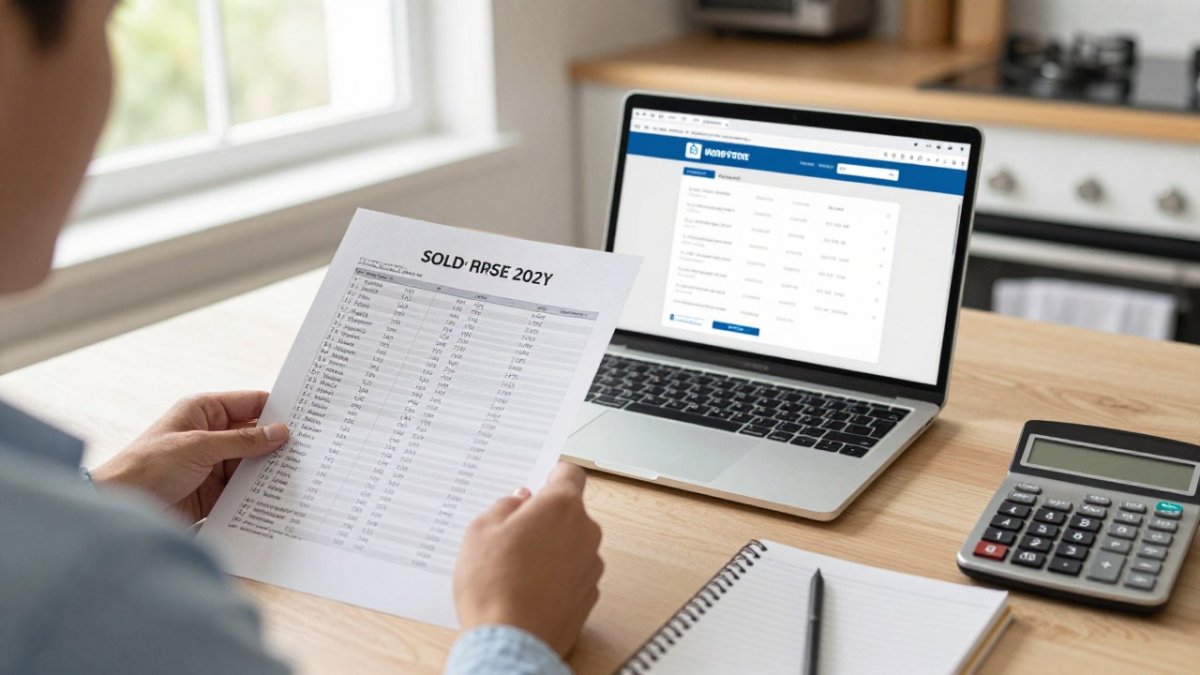
Select comparables on five criteria, then adjust for the differences
A comparable is only useful if you can explain why it is similar and where it differs. Work through these filters in order:
- Location: same street or within a few hundred metres, in the same local market and school catchment. A similar house on the other side of a main road or railway line can trade at a different level.
- Property type and tenure: a two-bed terrace compares to a two-bed terrace; a leasehold flat is not comparable to a share-of-freehold flat without adjustment.
- Size: use floor area from the Energy Performance Certificate or the portal listing, not bedroom count alone. A 70 sq m two-bed is not comparable to a 95 sq m two-bed.
- Condition: a refurbished house is not comparable to one needing a new roof, rewiring and a kitchen. Note the condition of each comparable from the listing photographs and, where possible, the EPC.
- Sale date: ideally within the last six to twelve months. Older sales need adjusting for local price movement, which you can sense-check against the HM Land Registry UK House Price Index for the area.
Once you have three to five candidates, adjust each one towards the subject property. Add for features the comparable lacks (a garage, a garden, a better condition) and deduct for features it has that the subject does not. Keep the adjustments modest and written down; large adjustments usually mean the comparable is not really comparable.
HM Land Registry price paid data
Distinguish market value, asking price and achievable resale value
These three numbers are not interchangeable, and conflating them is how a nominal discount survives scrutiny it should not.
- Market value is the price a willing buyer pays a willing seller, both properly informed, with no pressure to act. It is what your adjusted comparables support.
- Asking price is a marketing figure. A reduction from £250,000 to £225,000 is a 10% discount to the asking price, not necessarily a discount to market value, the original asking price may simply have been too high.
- Achievable resale value is what you could realistically sell for after refurbishment, allowing for selling costs and the time a sale takes. It is usually below the best-case comparable and should be treated as the ceiling for your exit, not the basis for your purchase price.
A deal is only below market when your purchase price plus all acquisition and refurbishment costs sits below the supported market value, and ideally below the achievable resale value after costs.
Work the numbers through one deal
Suppose a two-bed terrace is advertised at £180,000 with a claimed market value of £220,000.
The property needs a new kitchen, bathroom and rewiring. Your line-by-line refurbishment estimate comes to £30,000, and legal fees, survey, stamp duty and holding costs add a further £8,000.
That is the calculation a sold house prices comparison exists to force. If the numbers only work when you accept the seller's valuation, they do not work.
Watch out: averaging the middle three comparables without adjusting for condition or size can produce a figure that looks rigorous but is simply the average of three different things. Adjust first, then average.
Use a Below Market Value Property Checklist to Test the Claim
A below market value property checklist turns a vague claim into a yes-or-no test. Run it before you view, and again before you offer.
- Three or more genuine comparable sold prices gathered
- Asking price compared against your own valuation, not the seller's
- Property history checked for previous listings and price reductions
- Ownership verified at HM Land Registry
- Refurbishment costs estimated and added to the purchase price
That last point matters. If a seller or sourcer cannot explain why the price is low, treat the discount as unproven. A motivated seller, a probate sale or a property needing work are all credible reasons.
Work Through a Full Property Refurbishment Costs Estimate
Refurbishment costs are where below market property deals quietly stop being deals.
Build your estimate line by line, not as a lump sum:
- Structural work: roof, damp, subsidence, structural movement
- Kitchen and bathroom: typically the largest single spends
- Rewiring and heating: often overlooked in older stock
- Windows, doors and insulation
- Decoration and flooring
Then add the costs people forget entirely: legal fees, survey fees, stamp duty, empty-period council tax and insurance. Your true acquisition cost is purchase price plus every one of these.
Compare that total against your comparable sales figure. If the margin has vanished, the deal was never below market. It was just cheap on paper.
Apply Property Sourcing Agent Due Diligence Before You Pay a Fee
A sourcing agent can save you months, or cost you thousands. The difference is due diligence done before you sign anything.
Ask for evidence, not assurances:
- Comparable sales behind every claimed discount, in writing
- A clear, fixed fee structure with no hidden extras
- Proof of how they verify ownership and title
- Named examples of completed deals with purchase prices
- A written refund or complaint policy
Watch out: the biggest risk is paying a large upfront fee before any deal is verified.
Before committing to a fee, read our breakdown of the hidden costs of a property sourcing agent so you know exactly what you are agreeing to.
Spot the Common Red Flags in Below Market Property Deals
Most bad deals share the same warning signs. Learn them once and you will spot them in seconds.
- Pressure to act fast with no time for checks
- No comparable sales offered, only a claimed value
- Large upfront fees before any evidence is shared
- Vague reasons for the discount
- No access for a survey or viewing
- Title or ownership that cannot be confirmed
One red flag is a question. Two is a walk-away.
If you want to see what a genuine below-market deal looks like in practice, browse the deals we've sourced, with purchase price, cashflow and return on each one.
Most bad deals share the same warning signs, and learning them once means you will spot them in seconds.
| Red flag | What it looks like |
|---|---|
| Pressure to act fast | No time for checks |
| No comparable sales | Only a claimed value offered |
| Large upfront fees | Charged before any evidence is shared |
| Vague reasons | Discount not properly explained |
| No access | Survey or viewing refused |
| Title or ownership | Cannot be confirmed |
| Rents quoted | Local listings do not support them |
Check Legal and Physical Risks Before You Exchange Contracts
Legal and physical checks are the last line of defence before your money is committed. Skipping them is how investors inherit problems they cannot see. The discipline is to run a structured due-diligence checklist and feed every finding back into your valuation, rather than treating the checks as a box-ticking exercise separate from the price.
Legal due diligence: what your solicitor should confirm
Instruct a solicitor who acts for you, not the seller, and ask them to report specifically on:
- Title and ownership: confirm the registered proprietor at HM Land Registry matches the seller, and check for any cautions, notices or restrictions on the title.
- Tenure: establish whether the property is freehold, leasehold or share of freehold. For leasehold, obtain the lease and check the unexpired term, ground rent, service charge, review clauses and any restrictions on subletting or alterations.
- Boundaries and rights: check the title plan and any rights of way, easements or covenants that could affect use or resale.
- Planning and building regulations: ask for evidence of planning permission and building regulations sign-off for any extensions, loft conversions or structural alterations. Unauthorised works can be regularised, but the cost and risk sit with you.
- Local authority searches: the standard local search, drainage and water search, and environmental search. In some areas a coal mining, radon or flood search is also appropriate.
- Seller's property information form: review the replies carefully for disputes, alterations, guarantees and known defects.
Physical due diligence: what the survey must tell you
Commission a survey proportionate to the property's age and condition, a HomeBuyer Report for a conventional property in reasonable order, a full building survey for older, extended or visibly tired stock. Ask the surveyor to comment specifically on:
- roof condition and remaining life
- damp and timber defects
- structural movement and subsidence
- wiring, heating and drainage
- windows, doors and insulation
Then reconcile the survey findings against your refurbishment estimate. A survey that reveals a roof replacement or structural work is not a reason to walk away automatically; it is a reason to revise the numbers and, often, to renegotiate the price.
Turn findings into a revised offer, not just a report
Due diligence should change your position. If the survey uncovers £12,000 of unforeseen work, your maximum offer falls by at least that amount, plus a contingency for what the work uncovers once started.
A property can be below market value on the headline price and still be a poor investment once legal and physical risks are priced. Once legal and physical risks have been priced, the same discipline can help you find investment property deals whose apparent discount stands up to scrutiny.
Book a Free Call to Have Your Deal Figures Independently Checked
Verifying below market property deals is a skill, but you do not have to build it alone.
Talking Houses offers a hands-free service covering sourcing, refurbishment and tenant management, with a fixed and transparent fee structure, so you can invest from anywhere.
You can review our North East property investment and sourcing services to see which strategy fits, then book a free call and we will go through your deal figures line by line.
The gap between a genuine discount and a marketed one comes down to evidence.
Frequently Asked Questions
How do you check whether a property is genuinely below market value?
Pull completed sale prices for at least three genuinely comparable properties within the last six to twelve months, using Land Registry data and portal sold-price records. Adjust for condition, size and street, then compare that figure with the purchase price plus refurbishment costs. A genuine below market property deal still shows a discount after those costs are added. If the gap disappears once you include legal fees, survey findings and works, the deal is not below market.
What should a below market value property checklist include before I commit?
Your below market value property checklist should cover: three or more comparable sold prices, the property's full listing history and any price reductions, a surveyor's report, a refurbishment quote from a contractor who has seen the property, title checks and ownership verification, total acquisition costs including legal fees and stamp duty, and the achievable resale or rental figure. Cross-check every number the seller or sourcer gives you against an independent source before you exchange.
How do I verify the figures provided by a property sourcing agent?
Ask for the addresses of the comparable sales used to support the valuation, then check each one against Land Registry data yourself. Request the sourcing agent's fee structure in writing, including any upfront fees, and confirm what happens if the deal falls through. Property sourcing agent due diligence also means checking their complaints history and whether they are a member of a redress scheme. A sourcer who cannot show verifiable sold prices is asking you to trust a marketing claim, not a valuation.
What costs should I include when assessing a below-market property deal?
Add legal fees, stamp duty, survey costs, mortgage or broker fees, and a contingency of at least 10 per cent on refurbishment costs. Include the cost of any void period before a tenant moves in, plus management fees if you will not run the property yourself. Only after those figures are subtracted can you see the real discount. A property advertised at 15 per cent below asking price can end up at market value once refurbishment costs and upfront fees are counted.
